
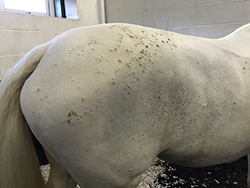
Summer time is hopefully a period that we are blessed with good weather and sunshine and while this is inevitably good for the soul, the sunshine and resulting UV, sadly can have negative implications for our equine patients namely in the form of sunburn and photosensitization.
The first, simple sunburn, occurs when light- coloured skin, including flesh marks, becomes red and scaly following excessive exposure to UV light. Similar to humans, the severity of the damage depends on the strength of the radiation and the individual’s skin sensitivity. Light-coloured skin is predisposed due to a lack of melanin pigment which absorbs UV light and scatters the radiation. Hairless skin is also more severely affected. The most common affected area is arguably the muzzle.
Mild cases generally self-resolve provided further exposure to UV light is prevented and the skin is given a chance to heal. More severely affected patients require veterinary attention and topical medications are frequently indicated (usually steroid-based creams).
Prevention is based on avoiding exposure to intense sunlight by stabling at periods of intensity, use of water-repellent sunblock and if the muzzle is an ‘at risk’ area, use of a face shade mask (which includes a shade to cover the muzzle area).
Ragwort
· Whilst intact, ragwort is generally quite unpalatable and horses don’t tend to eat it unless no alternate forage is available. Ragwort becomes much more palatable for horses when it is treated using a herbicide but hasn’t yet fully decomposed or when it is cut down and subsequently dries out. Therefore, one of the main sources of exposure to our horses is when it is inadvertently incorporated into hay or haylage.
· The toxin in ragwort, pyrrolizidine alkaloid, is generally a cumulative toxin. While a toxic dose may be consumed on one occasion, it is much more common for a patient to consume the toxic dose over a longer period of time i.e. years.
· The toxin causes irreparable damage to the patient’s liver which can lead to liver failure which is fatal. Clinical signs of liver failure are often only apparent when greater than 75% of a patient’s liver is affected. Clinical signs include depression/abnormal demeanor, reduced appetite, weight loss, jaundice, diarrhoea and photosensitisation to name but a few.
· Diagnosis is based on the presence of compatible clinical signs, with/without a history of grazing ragwort-infested pasture, blood work and ideally, a liver biopsy.
· Treatment is generally of a palliative nature.
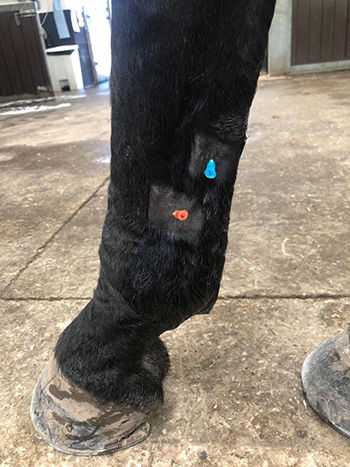 A nerve block is the deposition of local anaesthetic into the area immediately surrounding a nerve body or ending. This stops the nerve from transmitting signals relating to pain back to the brain, hence pain is prevented or “blocked”. Practically, the term nerve blocking is often used to describe the placement of nerve blocks in the truest sense, and also the deposition of local anaesthetic into joints and into the tissue surrounding the spinal cord (an epidural), rather than around nerves.
 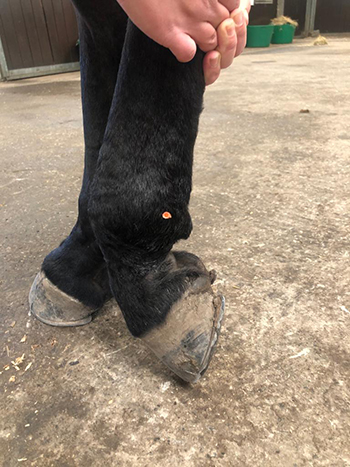 The procedure involves observing the horse moving in a straight line, on circles on both reins and on firm and soft surfaces. This allows grading and characterisation of the lameness. A nerve block is then placed, stopping the sensation of pain in a specific area. Once this has had chance to take effect, the horse is once again observed moving as previously. Any substantial reduction of lameness can therefore be attributed to pain coming from within the area that has been desensitised by the nerve block. If the lameness is unchanged, it can be deduced that the source of pain is not within the blocked area of the limb, and further nerve blocks can be performed to desensitise other area of the limb until the source of lameness is known.